Engineering Architecture & Mission Requirements
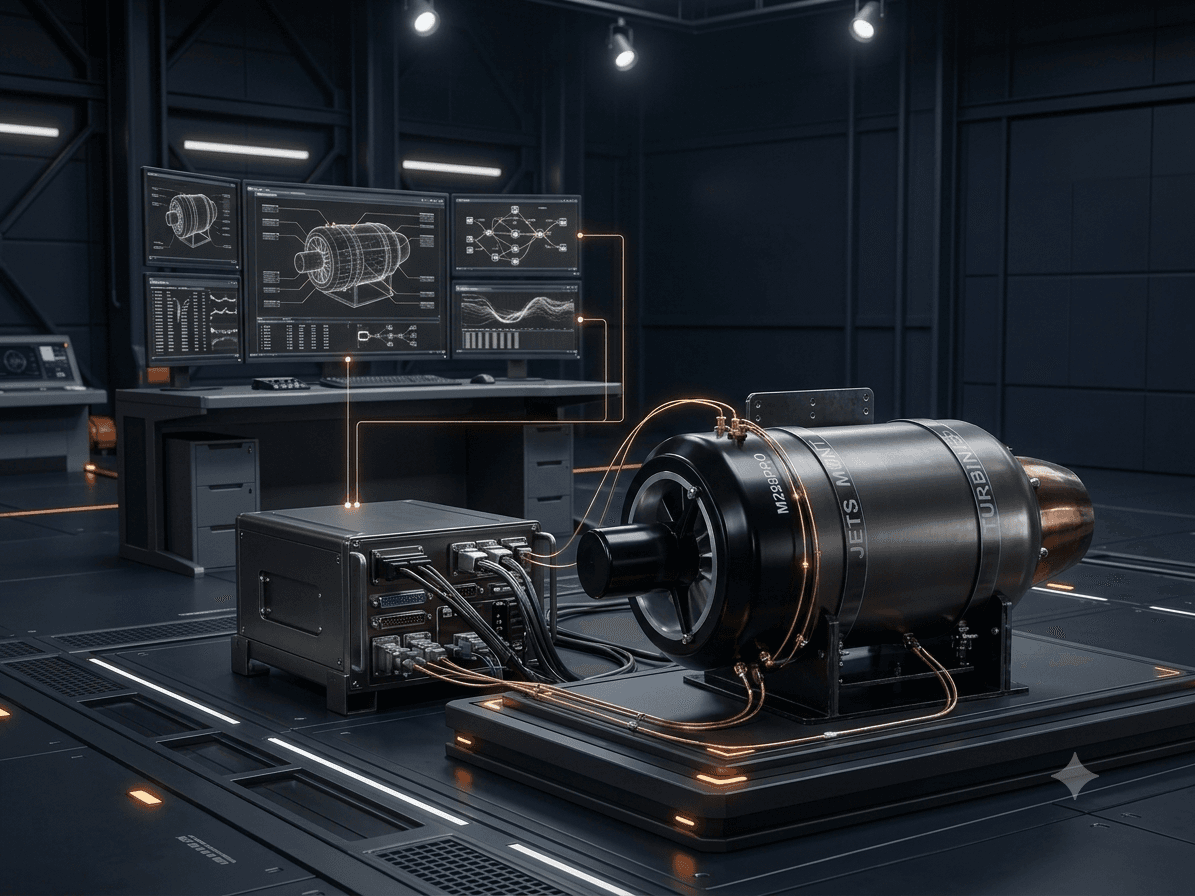
JetsMunt approaches microturbojet propulsion as a complete engineering ecosystem: engine hardware, integrated digital ECU, high-rate telemetry, thermal management, installation envelope constraints, and complete lifecycle support. Our mission is to de-risk propulsion integration early in the development cycle.
- Precision axial-flow microturbines optimized for aerodynamic wind tunnels and thermodynamic test benches.
- High-speed real-time telemetry output directly to university DAQ and dataloggers via CAN Bus and RS232 serial interfaces.
- Extensive validation for Sustainable Aviation Fuels (SAF), bio-kerosene, and Jet A-1 blends with full EGT and emissions logging.
- Integrated barometric and ambient temperature sensors for automated atmospheric compensation during indoor testing.
- Academic engineering partnership: CAD models, integration guidelines, and direct factory technical support for research departments.
Compatible Propulsion Classes
Strategic B2B Advantage
Why Aerospace Integrators Choose JetsMunt
100% ITAR-Free Sovereignty
Manufactured entirely in Spain within the European Union. Avoid US ITAR red tape and long export authorization delays with sovereign European propulsion systems.
Direct CAD & Avionics Integration
Direct access to .STEP files, 3D envelope models, and protocol documentation. Standardized CAN Bus and serial telemetry facilitate turnkey connection with onboard flight controllers.
OEM Program Customization
We collaborate with OEM platform engineers to adapt mounting lugs, starter sequences, generator outputs, and multi-fuel settings to match your exact mission envelope.
Technical Specifications & Insights
Frequently Asked Questions
Are JetsMunt microturbines suitable for wind tunnel and academic test bench applications?
Yes. Their compact axial-flow architecture, low rotor inertia, and precision factory balancing make them ideal for repeatable aerodynamic, acoustic, and thermodynamic research in university aerospace departments and propulsion laboratories.
How is engine telemetry interfaced with laboratory Data Acquisition (DAQ) systems?
The integrated 32-bit digital ECU provides native high-speed CAN Bus and RS232 serial telemetry streams. Real-time parameters include turbine RPM, Exhaust Gas Temperature (EGT), fuel flow rate, battery voltage, pump duty cycle, and barometric pressure.
Can these engines operate with Sustainable Aviation Fuels (SAF) and alternative blends?
Yes. JetsMunt turbojets are validated with Jet A-1, JP-8, automotive diesel, and various Sustainable Aviation Fuels (SAF / bio-kerosene) blends with 4% turbine oil, making them an excellent test platform for academic research into low-carbon aviation.
Does the ECU feature automated ambient and barometric compensation?
Yes. Integrated barometric pressure and ambient temperature sensors allow the digital ECU to automatically adapt fuel scheduling and acceleration ramps for indoor test cells and varying climatic chamber conditions.
Explore the propulsion stack